Experts agree on the strategic role of biomethane in the energy transition
The experts have analysed the role of biomethane in the different regions and agree on the need for good cooperation between the public and private sector to set targets and provide certainty in order to attract investment in this area.
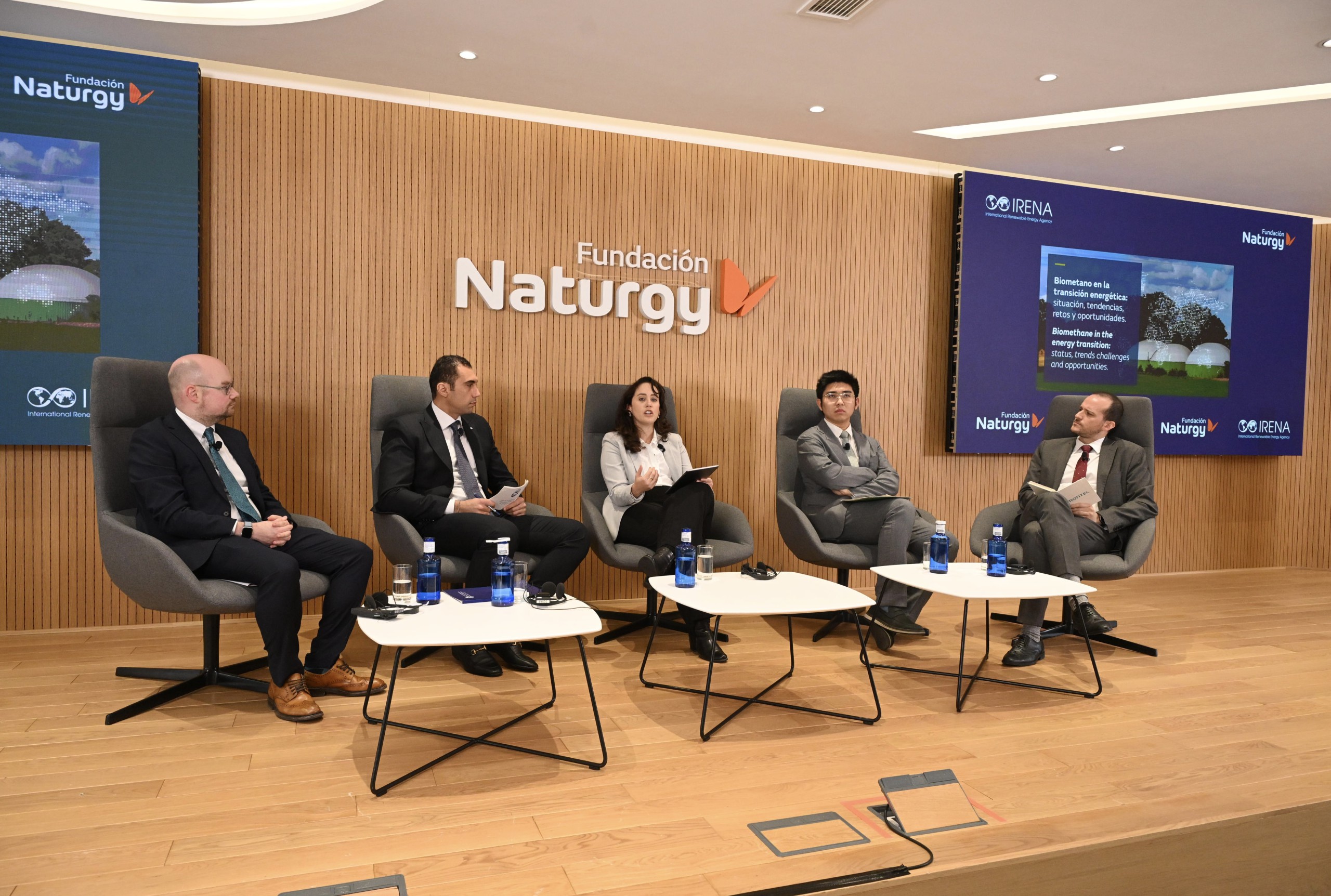
Naturgy Foundation and IRENA (International Renewable Energy Agency) held today the dialogue “Biomethane in the energy transition: situation, trends, challenges and opportunities”, a meeting to analyse the current situation, main trends and the challenges and opportunities of biomethane, as well as its key role in the energy transition.
The session addressed the current state of the world energy system in a context of renewable electricity dominance. During the presentation, James Walker, Renewable Gases Leader at IRENA’s Innovation and Technology Centre, said that to meet 2050 climate targets, renewable capacity must triple by 2030 and multiply up to nine times by 2050 compared to 2022 levels. Thus, in 2024, more than 90% of new installed electricity capacity was renewable, and solar and wind have established themselves as the cheapest technologies in most markets. However, while growth is accelerating, it is not yet sufficient to fully align with international climate commitments.
In this scenario of mass electrification, the role of biomass and sustainable fuels has evolved towards more strategic uses. This opens up particularly relevant industrial opportunities in economies that combine developed bioenergy markets with major renewable resources, enabling the integration of green hydrogen and sustainable carbon into new value chains.
Biogas can also make a difference as a fuel for sectors that are difficult to decarbonise, such as heavy transport or certain energy-intensive industries. According to Walker, many enabling solutions and frameworks are required to decarbonise these sectors.
The Renewable Gases Leader at IRENA’s Innovation and Technology Centre stressed that in order to boost biomethane development, it is essential to set clear objectives, support sector growth and have the backing of governments. Funding is key, as is technological innovation and the development of appropriate business models so these solutions can be applied in different local contexts. One of the main challenges facing biogas and biomethane is the dispersion of efforts and initiatives. To overcome this, better coordination is needed to ensure that facilities are properly maintained and operate efficiently.
Biomethane at the centre of the debate
The session brought together key players in the sector and encouraged the exchange of knowledge and good practices that are already being developed in this field during a discussion moderated by Pablo Bronte, editor and chief correspondent of Montel News for Spain and Portugal.
Yu Yuan, deputy secretary general and senior researcher of the Association for the Promotion of Bioenergy Industry and the Chinese Association for the Promotion of Industrial Development, stressed that “there is more and more interest in biomethane and biomass in China, and there will be big changes in this direction in the future. In this sense, the country must promote decarbonisation in order to achieve the targets set for 2030. It will be a very important year for energy, and biomethane will become more and more interesting”. Yuan also stated that “Chinese industrial users will focus on decarbonisation thanks to biomethane” and reported that large companies are currently aiming to reduce emissions by purchasing biomethane.
To conclude his intervention, he assured that “the construction policy the Chinese government has established has very tough targets for industrial parks, which must be 100% green energy if they want to qualify as zero emission parks and I think this is the best way to support this economy”.
Mohamed Alaa, energy expert at the Energy and Climate Action Division of the Union for the Mediterranean Secretariat, mentioned that they have the first climate report that has assessed the impact on the Mediterranean region and “we have seen the need to accelerate progress on green energy and energy transition”. Speaking about biomethane, Alaa said that “we can talk about a two-speed region: in the north it is strategic if we talk about energy security, while in the Southern Mediterranean there are strategies to treat waste and not so much to replace fossil fuels”.
Despite this, he pointed out that countries such as Egypt, Morocco, Turkey and Jordan are already incorporating biomethane into their energy strategies. “Although these programmes are still in their infancy. Biomethane can be crucial for energy security and is a strategic asset,” he added.
Alaa believes that cooperation between the public and private sector is very important. “The private sector wants to invest and participate, but they must have security, and for this public support is essential as it means providing confidence and allowing measures to be put in place that will attract the private sector, and therefore investment”. He concluded by stressing that “biomethane will be one of the possible solutions to decarbonise different sectors and we will see more growth, especially in the industrial sector”.
On the other hand, Karina Navarro, Policy Analyst and Environmental Engineer at the World Biogas Association, indicated that “the circular economy and renewable energies are not optional, they are a fundamental part of decarbonisation efforts. Biomethane is attractive in sectors where direct electrification can be difficult or expensive, such as steel, aluminium or heavy transport, and biomethane acts as a complement to electrification”.
Karina stated that “the success of biomethane markets is linked to good policies and legislative certainty. Countries that have well-established objectives are stronger. In this framework, the public sector has a decisive role to play in setting targets and priority sectors and in supporting infrastructure. Regulations and market incentives will attract investment.
James Walker, who also participated in the dialogue, said that “it is important to articulate the gaps and absences in the system and to think about what actions are needed to promote the different options. Gas is a very important part of the energy system and will play a relevant role in the transition, but what is more difficult is the development of new infrastructure”.
Walker also stressed that “it is essential to understand that biomethane is an additional or complementary tool, especially if we think about security of supply. Sustainability is a huge challenge for the sector, but we must work together to overcome it, because collaboration between countries and public support, whether through frameworks, regulations, mandates or targets that give confidence to the sector, are fundamental for the producer to be able to guarantee the product and then we can talk about a real market”.
During the conference inauguration, Rafael Villaseca, Chairman of the Naturgy Foundation, stressed that “the role of renewable energies is key to accelerating the energy transition and meeting the climate targets we have set ourselves. Biomethane is set to occupy a prominent place in the global energy mix due to its indigenous nature and its storage and management capacity. Moreover, we must not forget its contribution in the key area of waste management, one of the great challenges of sustainability. In this respect, biomethane can play an important role, closely linked to the principles of the circular economy, another key pillar of the sustainable transition”.
Francesco La Camera, Director General of the International Renewable Energy Agency (IRENA), emphasised that “the session comes at a particularly opportune moment. The aim is to foster a balanced conversation on the essential role of biomethane in the energy transition and its application in different sectors. Biogas and biomethane are solutions that have long received less attention than other renewables despite their enormous potential”. IRENA’s Director General stressed that “by 2050, more than half of the energy demand is expected to be covered by electricity, with an approximate 91% share of renewable sources. To achieve these objectives, we will need to analyse the economic alternatives available and also consider other critical elements of the system. Our analysis shows that bioenergy, including biomass, plays a very important role in meeting the needs of different sectors”.
Share