Experts warn that all sectors must adapt to climate change if they are not to lose competitiveness
Naturgy Foundation and the Spanish Chapter of the Club of Rome have held a new session of Conversations between experts focused on ‘Mechanisms for adapting to climate change’.
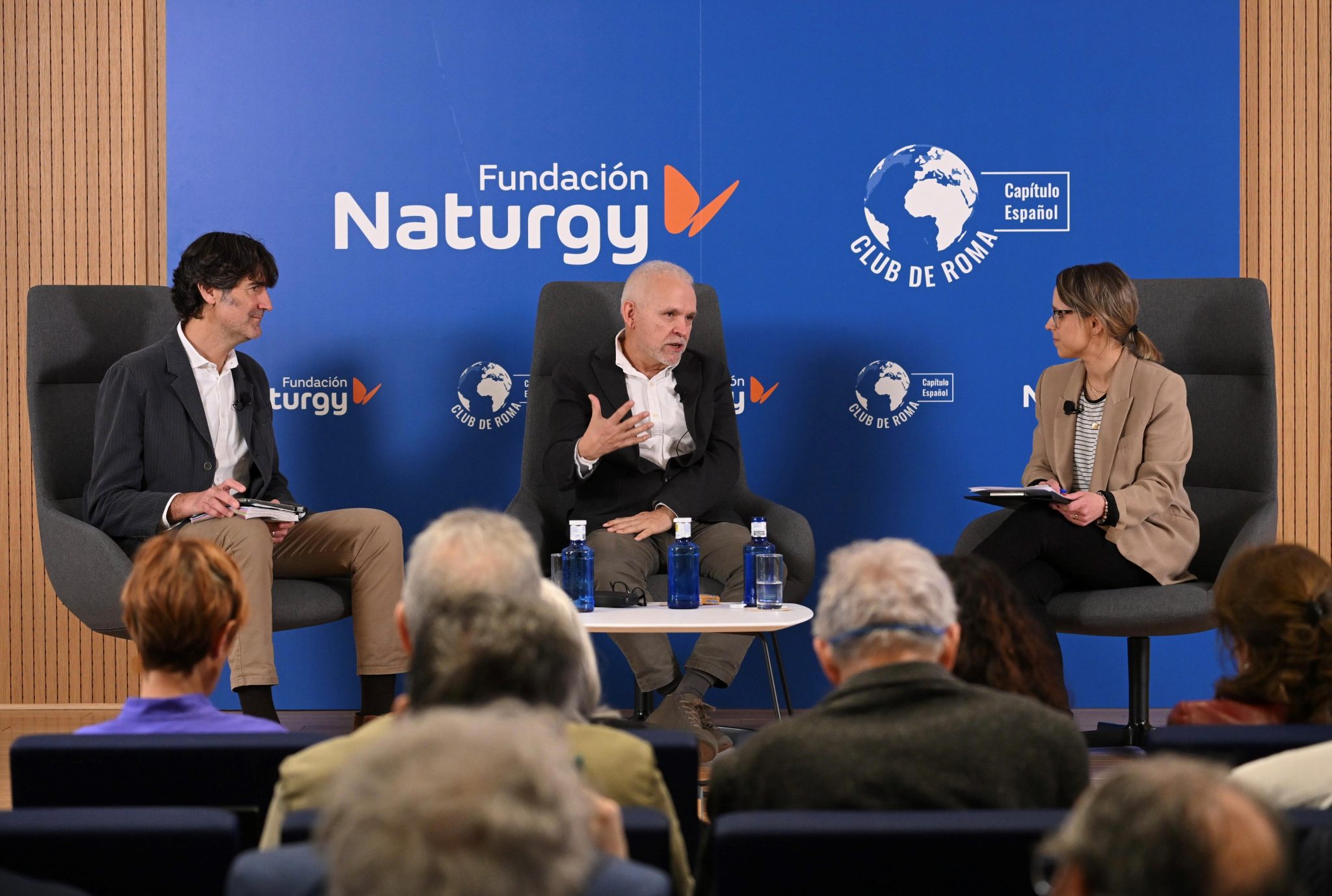
Climate change is a reality and all sectors must adapt to it to reverse it. Naturgy Foundation and the Spanish Chapter of the Club of Rome have organised a new session of their Conversations between experts, this time focused on ‘Mechanisms for adapting to climate change’, addressing current topics such as energy, environment or sustainability.
The session focused on the colloquium with Francisco Jorge Heras, Deputy Director-General for Adaptation to Climate Change at the Spanish Office for Climate Change, Ministry for the Ecological Transition and Demographic Challenge; and Efrén Feliu, Manager of the Adaptation to Climate Change, City, Territory and Environment Area at TECNALIA. María Eugenia Coronado, Director General of the Naturgy Foundation was also present to inaugurate the conference, and José Manuel Morán, Vice-President of the Spanish Chapter of the Club of Rome, was entrusted with closing the event.
Francisco Jorge Heras began his speech by stating that “administrations and companies must take into account that the impacts of climate change are generating problems for biodiversity, water, the economy, health, peace and security. So we must anticipate and prevent these impacts”.
Heras also wanted to focus on the National Plan for Adaptation to Climate Change, and that “one of the great successes of this Plan has been to ensure that adaptation to climate change is transversal in public policies: there are already more than 30 actions that incorporate these criteria. Key sectors such as infrastructure are advancing in diagnostics and identification of vulnerable hotspots, which is complex, but progress is steady. The same applies to housing, where climate change poses new challenges, such as overheating and energy impacts. Today, no one can conceive of designing an infrastructure that is not prepared to withstand climatic conditions”.
Referring to mitigation, he said that “adaptation without mitigation has a very bad prognosis. We have a certain margin to adapt, but it is not infinite, so we need to defend ourselves against the dangers and risks posed by climate change. But the causes must be tackled to curb the root of the problem, which is global warming due to greenhouse gas emissions. Adaptation and mitigation are two complementary responses and have many synergies”.
Francisco Jorge Heras also mentioned that “we must be aware that in order to face the future, what we knew in the past is not enough. We have to understand that we face new risks and we have to be cautious. The greater the uncertainty, the greater the caution, because unpredicted things can happen and can have serious consequences”. “We analysed the 51 key climate change risks in Spain and found that triggering a particular risk interacts with other risks and can end up generating unexpected effects,” he concluded.
Efrén Feliu said that at TECNALIA “we are developing digital tools to improve decision-making in climate change adaptation, with greater control in risk quantification and applying adaptive measures. However, the current context still requires further harmonisation of both data sources and analysis methodologies. Part of our work focuses precisely on advancing this standardisation, approaching it from a scalable perspective and applicable to different sectors such as energy or infrastructures”.
“Climate change impacts all sectors without exception, so the adaptation approach must be integrated into all areas of public and private management. From the natural environment or water to the urban environment or the financial sector, all are exposed. In this context, the energy sector plays a key role in setting priorities, but it is essential that we not fail to analyse any sector through the prism of adaptation,” said Feliu.
The TECNALIA manager stated that “we are planning mitigation with energy transition elements. Future generation conditions and energy demands will be different from today. And when rolling out mitigation actions, the effects of emissions must be taken into account”.
He concluded by stressing that “infrastructure security in the face of climate change is one of the great challenges of today. New designs already incorporate these variables, which is driving the development of more resilient materials, components and specific solutions. Progress is also being made in national infrastructure analysis and regulatory developments, in parallel with a growing level of awareness in both the public and private sectors”.
When opening the session, María Eugenia Coronado stressed “that adaptation to climate change is essential to anticipate the changes that will come and also to reduce the risks infrastructures are suffering from the natural disasters we have experienced in recent years, such as fires, floods and droughts”. Coronado reminded those present that “the Mediterranean region has traditionally been known by the scientific community as vulnerable in terms of climate mechanisms and we are currently working on ensuring that we all know where we stand in this regard”.
Finally, José Manuel Morán concluded the meeting by stating that “we are living in a time of enormous uncertainty, marked by geopolitical tensions and a growing questioning of scientific evidence, which makes it difficult to address climate change with the necessary urgency. However, its effects are already transforming our economies and territories, from tourism to agriculture, forcing us to adapt with new solutions. The key is to act with global solutions and adapt to local specificities, but with the human capacity to innovate and respond to unprecedented scenarios”.
Share