Experts warn that global climate progress still “falls short” of Paris Agreement targets
Naturgy Foundation and the Spanish Chapter of the Club of Rome have held a new session of ‘Conversations between experts’ focused on the evolution and compliance of environmental objectives in Spain and the world.
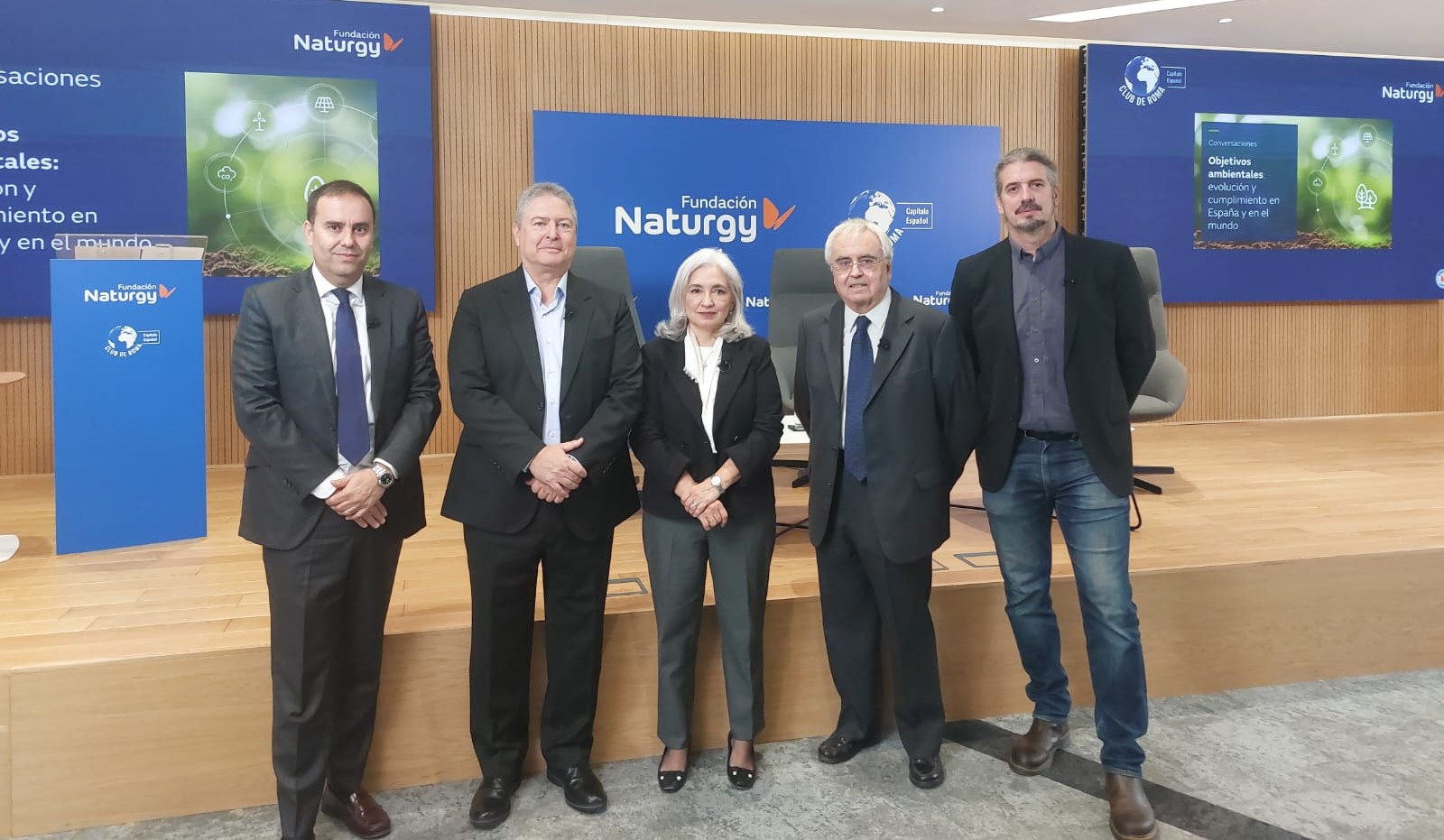
Environmental objectives set by various institutions, both at national and international level, have set the course for countries for the coming years. That is why Naturgy Foundation and the Spanish Chapter of the Club of Rome have organised a new session of ‘Conversations between experts’ on ‘Environmental objectives: evolution and compliance in Spain and the world’, which has addressed current issues on energy, environment and sustainability.
The session was attended by Óscar Barrero, partner in charge of Energy at PwC Spain, and Luis Robles, partner at Liken Carbon Hub, who participated in a debate moderated by Manuel Planelles, climate change, environment and energy editor at El País. María Eugenia Coronado, Director General of the Naturgy Foundation was also present to inaugurate the conference, and José Manuel Morán, Vice-President of the Spanish Chapter of the Club of Rome, was entrusted with closing the event.
During his speech, Óscar Barrero pointed out that, if we had to give a grade for progress in the fight against climate change, it would have to be an F. “It is true that there has been an effort, but the results have not been up to the objectives set. The goal of limiting global temperature increase to 1.5°C above pre-industrial levels has already been achieved, which shows that the commitments made have not been sufficient”. Barrero also added that “in the last five years, global emissions have increased by 4%, when we should have been reducing them, leaving us with an increasingly complicated path, which will require a much greater effort to redress the situation”.
Even so, Óscar Barrero affirmed that “within this unsatisfactory overall balance, there are signs of hope. While there are some political setbacks in some countries, business and civil society continue to make decisive progress. More and more economic and social actors are becoming aware of the effects of climate change, no longer as a future phenomenon, but as a present reality that conditions business, investment and consumption decisions”. Barrero also emphasised the need to take into account all technologies for decarbonisation as electrification is not and should not be everything.
Finally, speaking about the next COP to be held in the coming weeks, he mentioned that “the fact that it will be held in Brazil will give it a special character. We will have to see how to move from promises to action, especially on issues such as committed funding for developing countries or the promotion of a just transition that protects communities and biodiversity”. He stressed that, despite having a small share of global emissions, Spain must take on a leading role. “We are one of the territories most exposed to the effects of climate change, but also one of the best prepared to promote solutions, thanks to our resources, knowledge and industrial capacities”.
Luis Robles also wanted to highlight the value of holding of the next COP30 in Brazil, emphasising that discussions around the United Nations conference have evolved in a positive way, driven mainly by the commitment to climate finance and capacity building in developing countries. “More and more policies and measures are in place that make it impossible to turn back. Spain, like other countries, has a relevant role to play in adapting to climate change and must reinforce its commitment in sectors that still present major challenges, such as transport, industry and agriculture. Decarbonising power generation is not enough: we must also make progress in thermal energy and promote natural absorption”, he said.
“The next COP may mark a turning point. The challenge is to move from commitments to implementation, with inclusion and innovation at the heart of change. Funding will be key to progress, as will cooperation between powers such as China, India and the United States, whose role will be decisive in the global emissions balance. In the case of Spain, progress is evident, as emissions have been reduced below 1993 levels, demonstrating that it is possible to grow economically while reducing emissions. The objective now is to maintain this downward trend until the 32% reduction set by the PNIEC is achieved by 2030”, he concluded.
During the inauguration, María Eugenia Coronado stated that “today we are addressing a key issue, such as emissions and the real degree of compliance with decarbonisation objectives, both in Spain and globally. The latest reports by PwC and Liken Carbon Hub show that while some countries have made progress, the current pace is insufficient to meet the Paris Agreement”. She also stated that “in 2024, the average global temperature exceeded 1.5 degrees Celsius above pre-industrial levels for the first time, a clear sign of the urgency of the climate challenge. Europe continues to lead in environmental commitment, but with great internal differences since, while Germany and Nordic countries are making steady progress, others such as Spain and Italy are advancing more slowly, weighed down by transport and industry”. To conclude, she highlighted the important role of this event just a few weeks before a new COP as the context invites “profound reflection on progress achieved and the need to accelerate climate action in an increasingly complex geopolitical scenario”.
In closing, José Manuel Morán pointed out that “we are experiencing a crisis much greater than that of climate change, a crisis of global governance that is putting to the test the international system that we built after World War II”. “We are finding it increasingly difficult to reach consensus in a polarised world,” he said. However, Morán confessed that he remains optimistic that “companies, cities and society are understanding that moving towards less pollution and clean energy is not only an environmental obligation, but an opportunity. Spain, despite its political tensions, has matured as a society and has the capacity to lead this transition if it knows how to transform the present instead of just imagining the future”.
Share