Just transition and multilateral momentum, among the main consensuses highlighted after the COP30 analysis in Belém
High expectations for an unambitious result, another of the conclusions emphasised at the conference held by Naturgy Foundation and the Spanish Chapter of the Club of Rome.
Held this year in Belém, COP30 closed its sessions with a clear message: climate urgency requires accelerating global action and strengthening the commitments made by governments, business and society. During a week of intense negotiations, international leaders have focused on protecting the Amazon, just energy transition and climate finance as fundamental pillars to contain global warming and strengthen the resilience of the most vulnerable communities.
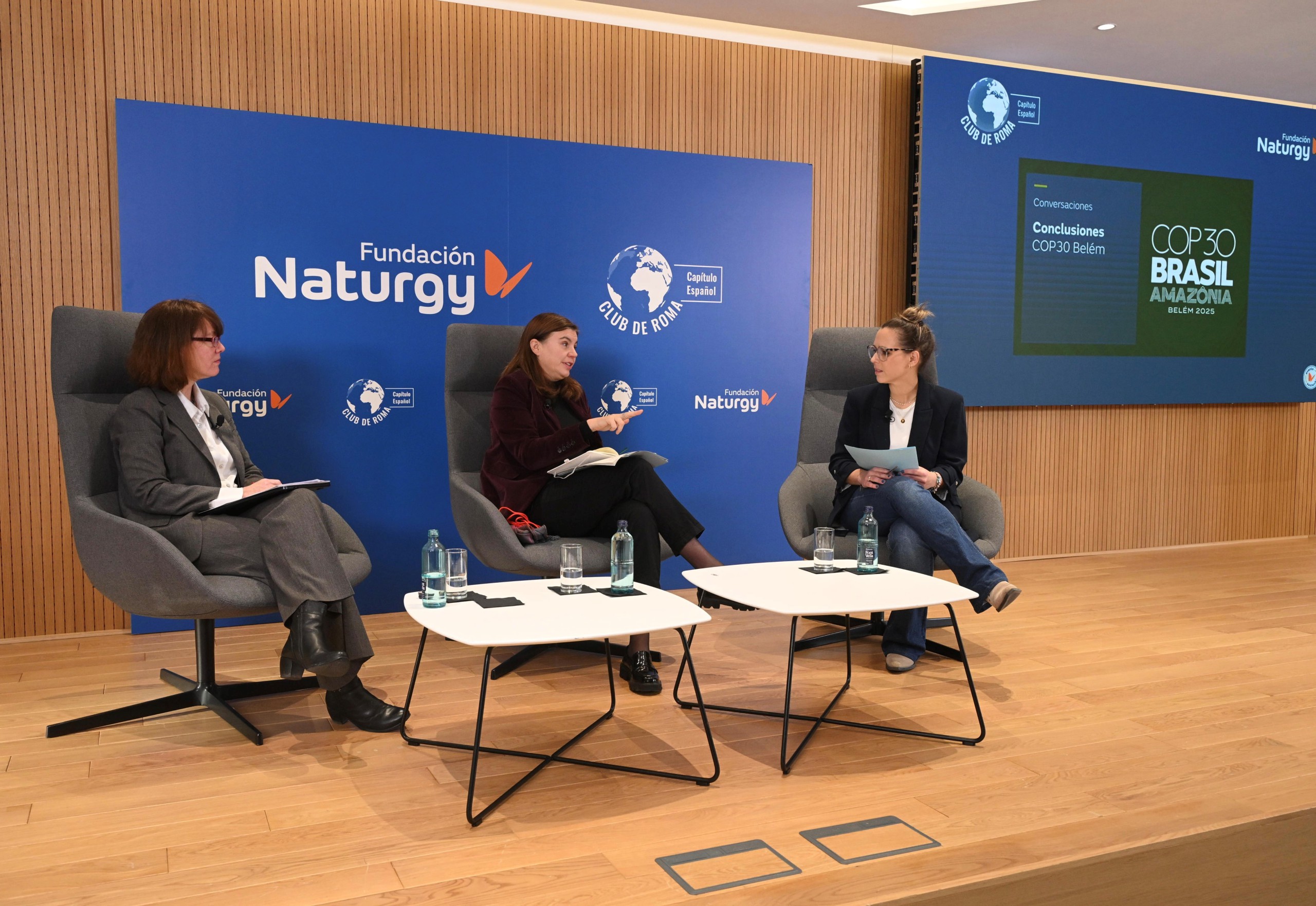
The Naturgy Foundation and the Spanish Chapter of the Club of Rome have organised a new session of ‘Conversations among experts’ to analyse the conclusions of the COP30 in Brazil, which also addressed the current situation of the energy sector, the environment and sustainability.
Elena Pita, Director General of the Spanish Climate Change Office of the Ministry for the Ecological Transition and Demographic Challenge (MITECO), and Lara Lázaro Touza, principal investigator at the Elcano Royal Institute and Professor of Economic Theory at the Cardenal Cisneros Higher Education Centre, participated in the session in a conversation to discuss the main conclusions of this year’s conference.
Elena Pita commented that “as the days go by since the COP, the sensations become more nuanced. Our expectations were very high and the result has not been as ambitious as we had hoped, especially in mitigation, but important progress has been made”. Pita stressed that “it is important to emphasise that the direction is the right one. We know what we need to do, we wanted to move forward with a roadmap that would tell us when and how to put a way forward on the table”.
When it came to analysing Spain’s role in the COP, Elena Pita stated that “it has played a leading role and highlighted the absence of the United States, which undoubtedly increases tension in the negotiations, but it can also be seen as a relief that there was no active blocking stance, as has been the norm. China has shown contradictions between its commitment to renewables and its large volume of coal emissions”. Pita also warned that “2024 was the first year in which the figure of 1.5ºC was exceeded and this must be put into perspective. The COP mission is to give policy-based signals and strategies, and the space for participation that is being given to non-governmental actors is growing”.
Lara Lázaro stated that “it has been an intense COP, like all of them, and this one even more so as it coincides with the tenth anniversary of the Paris Agreement. The projected temperature increase under current policies stands at 2.8 degrees and, as flexible, chaotic, insufficient and dynamic as it is, the Paris Agreement remains the compass towards which our development model is oriented. It was therefore disappointing to go from that roadmap to the final decision that was taken. Still, in the future we can see a push forward and a possible reform of the consensus that would allow some climate club agreements to be included in the annexes, so as not to slow down ambition. The presidency’s objectives, such as multilateralism, implementation and putting people at the centre, mark this path and, on this last point, the just transition agreement must be highlighted.
Lázaro also focused on the gender action programme, stressing that “discussions with countries such as Saudi Arabia are still open”. In the context of science, “the question of how best to include scientists from the southern hemisphere has also arisen. China’s role is relevant in this scenario as it is setting a target for reducing greenhouse gas emissions for the first time. The UK, on the other hand, stands out significantly for its ambition. And it is important to remember the difference we have made since the COP has been in place, that we went from forecasting increases of 3 to 4 degrees to 2.8. This framework works thanks to national policies and the growing demand for action from citizens”, she concluded.
At the start of the day, the session was opened by María Eugenia Coronado, Director General of the Naturgy Foundation, who stressed that “as in recent editions, this COP has been good and bad as significant progress has been made, but short-term challenges have also come to light. Picking up on the main headlines, we want to emphasise the most positive, such as consolidating the just transition approach, putting people at the centre of climate action”. Coronado focused on the geopolitical context, which “despite the particularly complex situation, has managed to preserve the multilateral momentum, which is essential to keep international commitment alive. From our perspective, we particularly value the adoption of the commitment to triple climate finance by 2035.
However, Maria Eugenia believes that the challenges are still enormous. “The climate gap remains wide and progress in implementation is not keeping pace with the demands of science. Current projections point to warming of more than two degrees Celsius, and differences between regions persist”.
The closing speech was given by José Manuel Morán, Vice-President of the Spanish Chapter of the Club of Rome, who stated that “the complexity of today’s world often leaves us without answers and puts even our intellectual and legal framework at risk. But the way COP30 has been approached in this forum has given us a little hope, perhaps to get back on the path on which the European Union was built”.
Morán analysed the current geopolitical situation as “a world where a declining power like the United States faces an emerging China, which combines advances in renewable energies with an unpredictable use of coal and which has key critical materials. This confrontation, coupled with the crisis of multilateralism, increases the sense of uncertainty that defines our times”.
Share