Naturgy Foundation and Spanish Red Cross renew their partnership to continue promoting social action and energy efficiency
Naturgy Foundation is the Spanish Red Cross benchmark energy entity in terms of energy vulnerability thanks to programmes such as the Energy Rehabilitation Solidarity Fund, the Energy School or the volunteer programme.
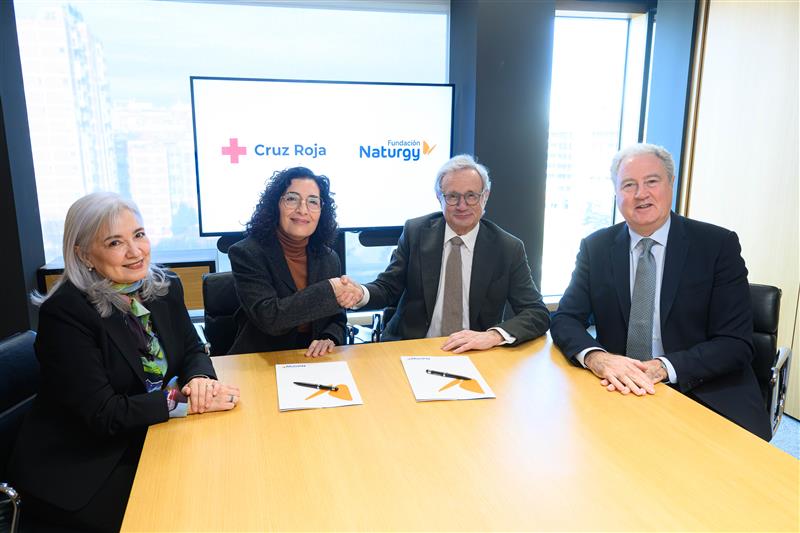
The Naturgy Foundation and the Spanish Red Cross have renewed their collaboration agreement, reaffirming a relationship that has become a benchmark in the fight against energy vulnerability and care for groups at risk. In place for nine years, this partnership seeks to respond to today’s social and energy challenges with initiatives that improve the quality of life of thousands of people. Since 2017, the joint partnership has served more than 23,000 families through different social programmes, 2,200 of them in the last year alone.
The Naturgy Foundation is the energy entity with the longest-running and most committed partnership with the Spanish Red Cross, becoming its benchmark in terms of energy vulnerability thanks to programmes such as the Energy Rehabilitation Solidarity Fund, the Energy School or the volunteer programme. These projects join more recent ones, like rural information points, which aim to help families in environments further away from the big cities.
Renewing the agreement will allow us to continue developing programmes that combine the experience of the Spanish Red Cross with the social commitment of the Naturgy Foundation. Both organisations share a common interest in the fight against energy poverty. In recent years, this collaboration has shown that the union between social organisations and companies is key to generating real impact. This partnership has promoted projects that not only improve energy efficiency in homes, but also help to reduce the social divide and promote sustainable habits among the most vulnerable families.
“At the Naturgy Foundation we understand that our role goes beyond energy: it is about contributing to people’s well-being. Collaboration with the Spanish Red Cross allows us to act where it is most needed, joining forces to get closer to the most vulnerable families, to understand their needs and be able to help them with training, advice and actions in their homes,” said Jordi Garcia Tabernero, Vice President of the Naturgy Foundation.
María del Mar Pageo, Chairwoman of the Spanish Red Cross, highlights the importance of having strategic partners to broaden the scope of its programmes and strengthen response to social emergencies. “Partnerships with committed companies, such as the one we have with the Naturgy Foundation, not only broaden the impact of our work by allowing us to help more people in vulnerable situations through the Fuel Poverty programme, but also help us to do so with a long-term perspective, contributing to the sustainability of the programme.”
Common goal: fight against energy poverty
During the nine years of collaboration, the Naturgy Foundation and the Spanish Red Cross have managed the rehabilitation of 1,750 homes of vulnerable families thanks to the foundation’s Energy Rehabilitation Solidarity Fund. These families have benefited from both improved energy efficiency in their homes and utility cost savings.
Within the framework of this agreement, during this year, 2,352 people have also benefited from energy training sessions given by the Naturgy Foundation Energy School, as well as by Naturgy and Spanish Red Cross volunteers. In these sessions attended by vulnerable families, technicians and volunteers from the Spanish Red Cross explain basic concepts of contracts, bills and updated regulations, as well as tips on how to make better use of energy in the home. To date, more than 266 training sessions and workshops have been carried out.
All this would be impossible without volunteers from the two organisations, who will continue to work on energy bill and efficiency workshops, giving personalised advice to people in vulnerable situations on their consumption, as well as on the subsidised rate and visits to homes to detect possible cases of energy rehabilitation. Currently, the Naturgy Foundation has delivered more than 17,500 micro-efficiency kits to Spanish Red Cross beneficiaries.
Next year, the Naturgy Foundation and the Spanish Red Cross will continue to focus on these same programmes, stepping up their efforts with their on-site volunteering in vulnerable households and boosting assistance to provinces where the greatest need has been detected in the fight against energy poverty so that the impact of the programme is greater. This is the case of Valencia, where the Naturgy Foundation has promoted its ‘Joining Forces for Valencia’ programme, taking the main lines of action of its Energy Vulnerability Plan to the territory affected by flooding. This plan not only seeks to collaborate in the repair of material damage, but also to rebuild and, if possible, improve the quality of life of those who need it most through initiatives that combine sustainability, energy efficiency and savings, carried out in collaboration with local social entities.
The importance of inter-agency cooperation
With this partnership, the Naturgy Foundation and the Spanish Red Cross consolidate a collaboration model that contributes to the Sustainable Development Goals and reinforces the business commitment to society. Both organisations will continue to work towards a just and inclusive energy transition, ensuring that the most vulnerable people have access to solutions that improve their well-being and future. The renewal of the agreement is part of the Naturgy Foundation’s strategy to integrate social sustainability into its activity, complementing its initiatives in education and energy transition with actions that have a direct impact on people’s quality of life.
Furthermore, the partnership reinforces the Foundation’s commitment to the social economy and public-private collaboration, demonstrating that cooperation between organisations is essential to face today’s social and environmental challenges. This work would not be possible without the third-sector entities, foundations, educational centres, companies, universities and government bodies with which it weaves partnerships to build a better future. The sum of everyone’s efforts enable it to continue adding value and help create a more humane and sustainable society.
Share