Social acceptance, territorial planning and local dialogue; keys to effective and sustainable renewable energy roll out
A report prepared by the Institut Cerdà points to the need to strengthen coordination between administrations, companies and local communities in order to turn renewables into an effective lever for economic development, territorial cohesion and the fight against climate change.
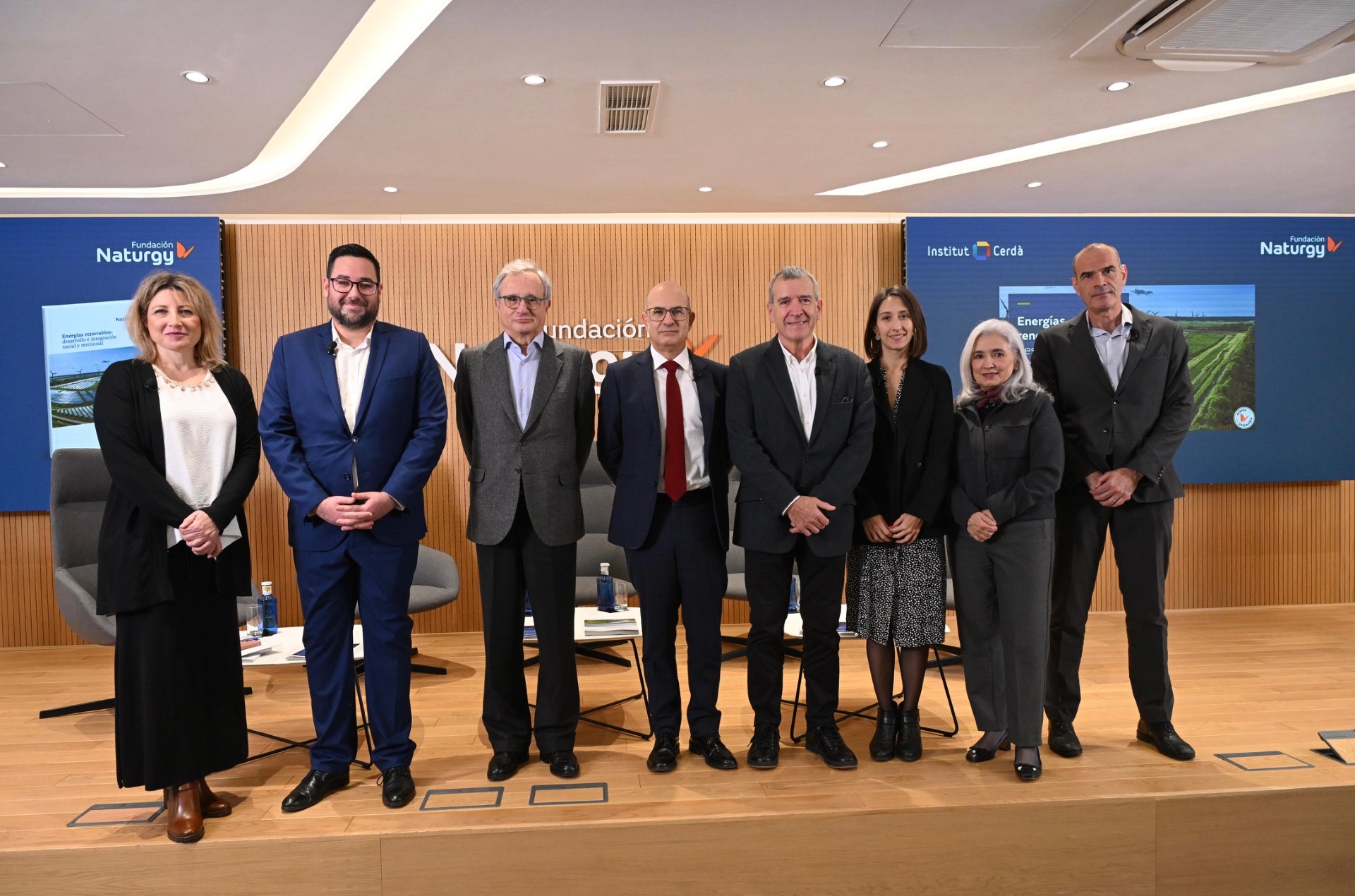
The Naturgy Foundation has presented the study “Renewable energies: development and social and territorial integration“, prepared by the Institut Cerdà, which analyses challenges and opportunities for rolling out renewable infrastructures in Spain from a social, territorial and public policy perspective. The document analyses the current climate and energy context, the process of implementing renewable projects and their relationship with the territory, identifying benefits, barriers and good practices. It also focuses on the importance of integrating projects in the territory and in local communities as an essential condition for moving towards an efficient, fair and sustainable energy transition.
The energy transition has become an unavoidable priority in order to move towards a more sustainable, secure and competitive energy model. In this context, rolling out renewable energies —with special emphasis on photovoltaic solar, wind and renewable gases such as biomethane— is key to reducing greenhouse gas emissions, reinforcing security of supply and complying with the climate commitments undertaken by Spain and the European Union.
The report highlights that Spain has one of the greatest renewable energy potentials in Europe thanks to its natural conditions and its industrial and technological capacity. The objectives of the National Integrated Energy and Climate Plan set out an ambitious roadmap towards 2030 and 2050. However, achieving these goals requires a mass roll out of energy infrastructures, accompanied by grids, storage systems and solutions to ensure system stability.
The document underlines that this roll out has a direct impact on the territory and local communities, especially in rural areas, where most of the installations are concentrated. While renewable energies generate significant economic, social and environmental benefits —such as job creation, boosting local development and improving energy autonomy— they also pose challenges linked to land use, landscape protection, biodiversity and coexistence with traditional activities.
Social acceptance and territorial integration are therefore determining factors for the success of the projects. The report emphasises the shared responsibility to maintain a continuous process based on early dialogue, transparency, active listening and the generation of tangible benefits for the environment. The lack of adequate social component management can lead to conflicts, administrative delays and judicialization of strategic projects for the energy transition.
Finally, the study proposes a series of good practices and recommendations addressed to all stakeholders, such as companies, public administrations, the social fabric and technical and economic agents. They all agree on a key message: only co-responsibility, rigorous planning and collaboration between all actors will make it possible to turn the roll out of renewable energies into a real opportunity for territorial development, social cohesion and an effective fight against climate change.
During the presentation of the study, Marta Bellera, Director of the Institut Cerdà’s Risk Management Area, explained that the accelerated roll out of renewables “is profoundly transforming the territory and local socio-economic dynamics”. According to Bellera, “the key is not only where projects are implemented, but how they are planned, how they are communicated and how their benefits are distributed”. The report underlines that Spain has an extraordinary renewable potential, but warns that administrative complexity, project judicialization and lack of social acceptance may slow down the pace needed to meet climate targets.
Commitment to the territory
The subsequent colloquium brought together representatives from public administration, business, territorial analysis and local government. Francés Boya, Secretary General for the Demographic Challenge of the Ministry for Ecological Transition and Demographic Challenge, pointed out that “the implementation of renewable energies is not a magical or uniform solution, because we are talking about unique territories with very different realities, structures and sensitivities. Today no one can argue that we need renewable energy, but its development must be based on a thorough knowledge of each territory and what the people who live there expect”.
Jorge Barredo, General Manager of Renewable Generation at Naturgy, said that the group has been present in the rural environment for more than 25 years with wind farms that are still in operation. “Our strategy is to optimise land use, recondition spaces and ensure that, once the plants’ useful life is over, the environment can be restored to its original state. In this sense, renewables should be understood as a long-term reserve of territory and not as usurpation. These installations provide a backbone for the rural environment, generate employment and develop compatible activities such as livestock farming and agriculture. The key is to coexist, to collaborate with the territory and to comply rigorously with increasingly demanding environmental impact statements”.
From the territorial perspective, Lluís Inglada, Director of the Territorial Management and Innovation Area of the Institut Cerdà, believes “it is necessary for the territory to be an active actor in energy projects, but ensuring that the response is not only emotional, but based on strategy and logic. The complexity of these processes often falls on public decision-makers, who can balance the individual interests of citizens and avoid stalling projects. This is why companies have evolved in recent years by incorporating social elements and improving the way they explain projects”.
The municipal level was represented by José Díaz Ibáñez, Mayor of Tabernas (Almería), who highlighted the role of local councils in the roll out of renewable energy. Díaz Ibáñez pointed out that “renewable projects represent a real opportunity to attract investment, generate employment and boost the local economy. Even so, it is still essential to improve information and communication, as well as to reinforce the companies’ commitment to local employment and land restoration after the end of the activity, so that plant integration is even more accepted by the population”.
The conference was opened by Rafael Villaseca, Chairman of the Naturgy Foundation, who stressed that “the energy transition is a major collective challenge that cannot be tackled solely from a technical or regulatory perspective”. He stressed that “integrating renewables into the territory, listening to local communities and generating shared value is essential to guarantee project viability and strengthen social trust in the transition”.
Share