Spain and Europe in the face of energy volatility: renewables, regulation and investment as levers
Kadri Simson and Raymond Torres led a new session of these high-level conferences, focusing on how to strengthen the security and competitiveness of Spain and Europe in the face of energy volatility through renewables, regulation and investment.
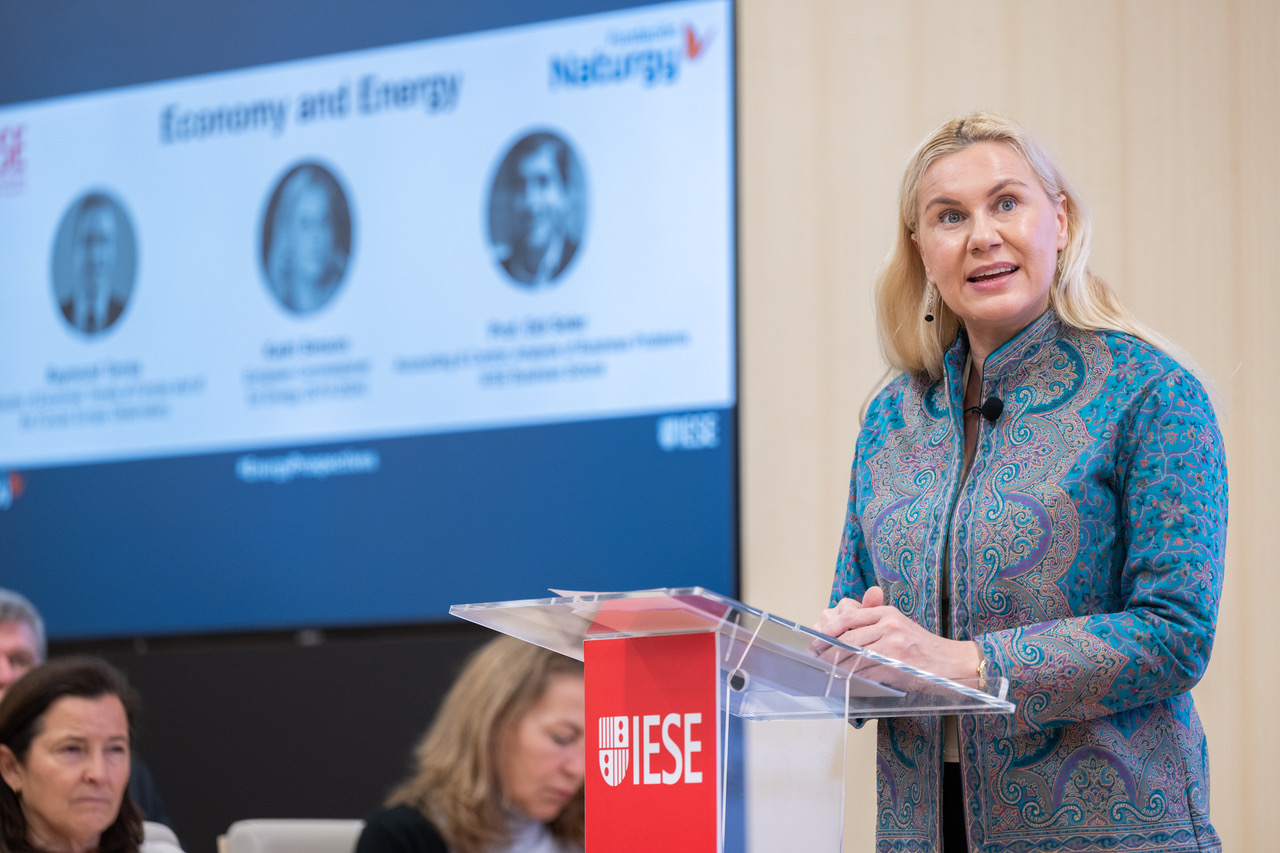
Kadri Simson, former European Commissioner for Energy during the mandate of the First Von der Leyen Commission, and Raymond Torres, Director of Economic Situation of Funcas and the Funcas Europe Observatory, were responsible for the 22nd session of high-level conferences of the year organised by Naturgy Foundation and IESE Business School. In this new edition, the guests shared their views on the state of the world economy and its implications for the future of energy in a colloquium moderated by Edi Soler, Associate Professor of Management Practice in the Department of Accounting and Control at IESE Business School.
Kadri Simson noted that “for a long time, political debate in Europe focused on the trade-off between affordability and security of supply. Before 2022, the European energy agenda prioritised low costs over strategic independence. About 20% of Europe’s energy imports came from Russia, and in that year, following tensions with gas suppliers, Europe paid around 640 billion euros in fossil fuels. Following this crisis, energy policy began to focus strategically on three elements: security, prices and sustainability”.
According to Simson, “there is consensus on climate laws, but the key question is whether Europe will be able to comply with them. One of the key objectives is not to become strategically dependent on other countries again, as was the case in the past. Energy markets remain volatile due to geopolitical tensions, for example, in the Gulf. However, progress has also been made. The price per barrel is currently around 56 dollars, down from around 100 dollars in 2020, showing some progress in stabilising the market. Furthermore, in 2025, renewables overtook fossil fuels for the first time in Europe, considered one of the continent’s great energy achievements”.
Kadri stressed that “one of the main challenges is to replace imported gas with gas produced in Europe. Biomethane appears to be one of the most promising alternatives in this respect. Biomethane is produced on European soil, can be transported through existing gas pipelines and represents a cleaner and economically viable option. Europe cannot substitute one strategic dependency for another, especially in a context of new threats such as trade tensions or tariffs. This is why it is essential to develop sound and sustained energy policies that reduce fossil fuel use and improve economic efficiency”.
Despite this, Simson commented that “European industry faces a clear problem of energy competitiveness. Energy prices in Europe are about twice as high as in the US and also higher than in China. Accelerating the transition to green energy, boosting industrial electrification and decarbonisation, and combatting unfair international competition are proposed to address this challenge, while protecting European industry”.
The former European Commissioner for Energy concluded by stating that “the energy transition is inevitable and necessary. And the energy issue remains at the centre of European debate. Europe imports about 90% of its oil and gas and will continue to be exposed to volatile markets. However, important steps have been taken to strengthen energy security, such as new gas storage standards or international agreements to diversify suppliers. The challenge now is to keep up the momentum and not become complacent. As noted, Europe is better off today than in 2022, but the real challenge will be to stay the course towards an energy transition that combines security, sustainability and competitiveness”.
During his speech, Raymond Torres stressed that “we have been talking about renewable energies and Europe’s energy independence for at least ten years and, if we look at the data, for example, in terms of power generation, in the case of Spain we would be at approximately 59% of electricity production that comes from renewable energies. However, the ups and downs of the international economic situation affect us greatly. Whatever the crisis or its origin, it has a particular impact and, at the moment, since the conflict in Iran, what we are seeing is an increase in the cost of energy for companies and citizens in Europe that is higher than what is being experienced elsewhere, for example, in the United States. In other words, there is a kind of tension and contradiction”.
Torres indicated that this paradox had to do with three specific elements: “the first is an investment deficit. Europe invests approximately 1.5 points less of its GDP each year than the United States and has had a very large investment deficit for at least ten years, since the financial crisis; the second element has to do with competitiveness, and in particular energy prices. Generally speaking, there is no structural competitiveness problem in Europe. If we look at indicators such as unit labour costs, in many cases they have grown at par or even slightly less than in the US. However, we do have a problem of competitiveness in terms of energy prices in Europe, although it is true that Spain’s situation is different in this case as the price of electricity is approximately 20% below the European average; and the third element has to do with regulation and predictability. We continue to observe a very clear coincidence between gas price variations and electricity price variations, even in the very short term. This introduces high volatility in energy prices and maintains a vulnerability that persists even as the share of renewables increases”.
Torres also wanted to focus on biomethane as an alternative to solve the energy trilemma. “Some technologies can help solve this. Nuclear energy, for example, may be part of the solution in some countries, but also other alternatives such as biomethane, which can help strengthen security of supply and advance the energy transition. The important thing is that any decision is taken with a certain predictability, because investors need to know what the energy scenario will be in the coming years”.
To end his speech on a positive note, Torres said that “even so, there are reasons for some optimism. If you had asked us five years ago how Europe would withstand an energy crisis, the invasion of Ukraine, trade tensions and new geopolitical crises, we would probably have predicted a much worse outcome. The European economy has shown remarkable resilience. And the second reason for optimism is that when Europe needs something, urgency kicks in. In many cases we know what the solutions are, what we need is that sense of urgency to mobilise investment, strengthen market integration and advance the energy transition”.
Rafael Villaseca, Chairman of the Naturgy Foundation, was present at the start of the session and stated that “providing all stakeholders in the energy world with a vision of depth and scope offered by relevant figures from the world of economics, energy and business is one of the fundamental objectives of the Foundation”.
Villaseca added that “it is almost impossible to think about economic crises without talking about energy. The impact that energy has had on economic crises, or the economic crisis on energy, has been and continues to be decisive. The energy sector trilemma is, once again, disrupted by geo-strategic factors, with the price skyrocketing, security in question and confidence that these situations will be reversed today is in great question”.
Share