The gas network reinforces its role as a guarantor of supply and a cohesive element in a more flexible and diversified energy system.
The report ‘The role of the gas distribution network in the Spanish energy system’, prepared by Deloitte and published by Naturgy Foundation, places the gas distribution network as a strategic asset to ensure security of supply, territorial cohesion and the efficient integration of biomethane in Spain.
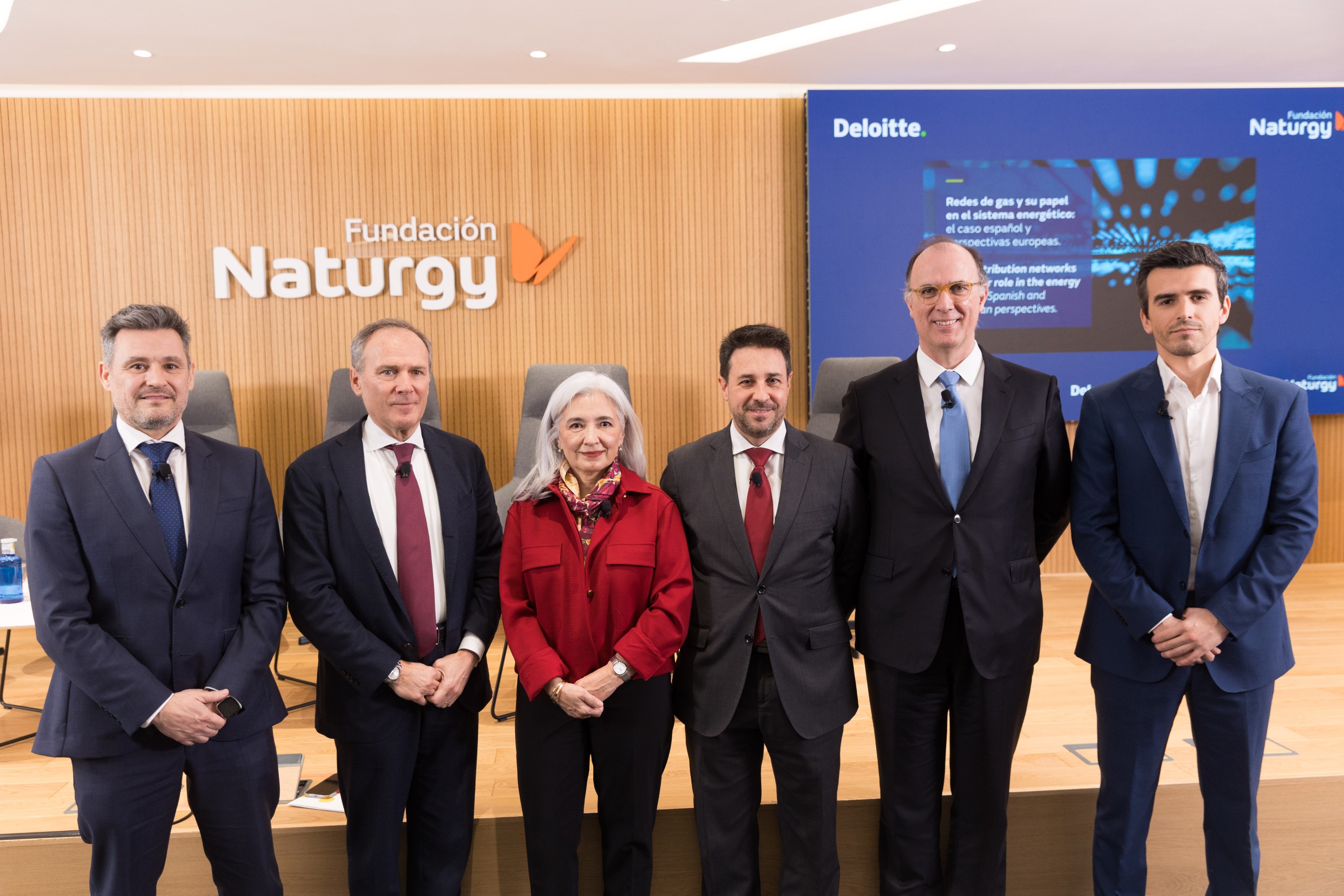
The Naturgy Foundation has presented the report ‘The role of the gas distribution network in the Spanish energy system‘, prepared by Deloitte, which analyses the current contribution of gas to economic and social development, the role of the distribution network as a critical infrastructure and the challenges that the energy system will face in its progress towards decarbonisation. The document concludes that gas distribution networks will remain an essential infrastructure for energy security, industrial competitiveness and the country’s energy transition in the horizon of a net‑zero energy system.
The study identifies four key attributes that consolidate the strategic value of these infrastructures: capillarity, resilience, biomethane integration capacity and digitalisation. These pillars enable networks to continue to provide resilience, flexibility and territorial cohesion in a context of increasing electrification and higher penetration of renewable energies.
A critical infrastructure for security of supply
According to the report, the gas distribution network is today an indispensable asset for securing the country’s energy supply. With more than 96,000 km deployed and around 8 million supply points, the network directly supplies 20.4 million people and offers potential access to a further 6.5 million thanks to its vast territorial proximity.
Thermal consumption of Spanish households has a marked annual seasonality, with differences of up to a factor of 17 between summer minimums and winter maximums, which requires an energy vector capable of responding flexibly and firmly. Peak-dimensioned gas networks with intrinsic storage ensure this reliable supply in severe cold spells, covering the comfort of millions of citizens.
This capillarity makes it possible to cover the thermal needs of large urban and industrial areas, but also of thousands of municipalities with cold climates or livestock and agricultural activity, where thermal demand is high and stable. Eighty-five percent of Spanish municipalities have medium or high heating needs, demonstrating the network’s structural value for the well-being of millions of households.
System resilience is confirmed in peak demand management: the daily peak has grown by 7% in recent years, while average demand has remained virtually stable. In the power sector, gas has reinforced its backup role in stress situations, especially since the April 2025 blackout, with an increase of more than 50% in generation to cover system constraints.
Biomethane revalorises the distribution network as a key decarbonisation vector
The report concludes that biomethane will be one of the most immediate and efficient ways to reduce emissions in thermal uses and in industrial sectors that are difficult to electrify. Its full compatibility with the existing infrastructure allows the use of existing networks, boilers, equipment and meters with no need for modifications. According to the report, this integration capability provides the consumer with a real choice.
Spain has a high potential for biomethane production from livestock, agricultural and urban waste. This resource is distributed throughout the territory, and between 80% and 90% of this activity is located close to the distribution network, making it the most efficient platform for transporting this renewable gas.
Deployment requires a network capable of handling bi-directional flows through reverse flow stations, which allow locally produced biomethane to be evacuated to other areas with higher demand. Countries such as France already have more than 30 operational units of this type, while in Spain, Naturgy has developed the first reverse flow installation in Capellades (Barcelona), which technically validates this model.
Thus, the gas network not only preserves its value as a critical infrastructure, but also expands the decarbonisation options available to citizens, aligning security, efficiency and technological neutrality.
Digitalisation: the backbone of the network of the future
Digitalisation is identified in the report as an essential enabler of the distribution network of the future. Its implementation will make it possible to manage an increasing number of injection points, ensure gas quality and optimise operation in real time. The study highlights the need to incorporate advanced sensors, SCADA systems, chromatographs, telemetry, smart meters and digital twins. These technologies make it possible to manage pressures and flow rates, monitor gas quality, optimise the line pack, and ensure secure and efficient operation in a distributed generation environment.
The Ministry for Ecological Transition and the Demographic Challenge (MiTEco) is also working on the progressive deployment of smart meters, which will improve consumption efficiency, reduce losses, facilitate the integration of renewable gases and improve transparency for consumers.
The presentation of the study, by Alberto González-Salas, Energy partner at Deloitte, was followed by a colloquium on ‘European Perspectives’, moderated by Arturo Lopo, economic journalist at TVE, in which Raúl Suárez, CEO of Nedgia; Paolo Gallo, CEO of Italgas; and Gabriel Sousa, CEO of Floene, also participated.
Raúl Suárez stressed in his speech that “the gas distribution network represents an asset whose solidity and capillarity will continue to be decisive in guaranteeing a secure, efficient and prepared energy system for the challenges of the coming decades. Ninety-nine percent of residential and industrial demand is connected, and most green gas is generated, in the distribution network, so it is critical for the economic development of the territory and, consequently, it is a fundamental part of the Spanish energy model”.
In relation to green gas, Suárez stated that “the progressive incorporation of renewable gases and network digitalisation will allow the distribution network to make the most of its potential as an enabler of an orderly, realistic energy transition aligned with the country’s decarbonisation commitments, without affecting the competitiveness of industry and the economy of families”.
Regarding Nedgia’s role in the future, the distributor’s CEO emphasised that “the evolution of the gas network towards a more intelligent, flexible and distributed generation-ready model will consolidate its role as a critical infrastructure in an increasingly complex energy system. Our commitment is to continue driving this transformation so that the network continues to bring value to homes, businesses and industry, integrating new technologies and renewable vectors with full guarantees”.
Paolo Gallo stated that “the energy transition, to be successful, must address the energy trilemma — decarbonisation, security of supply and affordability. Europe needs an integrated system in which electrons and renewable molecules work together. Flexibility is essential: molecules can be stored on a large scale, whereas electricity cannot yet, at least not efficiently. This is why existing gas networks are not a legacy of the past, but a strategic asset to accelerate decarbonisation in a resilient and cost-effective way.
The Italgas CEO stressed that “we have fully digitalised our distribution networks and are increasingly adopting artificial intelligence to improve security, optimise operations and enable large-scale integration of renewable gases. Biomethane is already a mature, locally produced solution that strengthens energy independence and supports the circular economy, while hydrogen —including its blending into existing networks— can offer measurable emission reductions today and help build a scalable pathway for the future”.
Gabriel Sousa defends gas networks as a strategic pillar for a balanced and competitive energy transition. Floene’s CEO stressed that Portugal’s energy transition must be guided by pragmatism, balance and a systemic approach. “The transition is not electricity or gas: it’s electricity and green molecules. We need a hybrid, resilient and accessible system,” he said.
Sousa stressed that the gas network remains a critical asset for the security and flexibility of the national energy system. According to Floene’s CEO, total energy demand in Portugal —which combines electricity and gas— could increase by 23% by 2050, driven mainly by industrial growth and the advance of new energy-intensive uses such as data centres. He warned that “electrification alone cannot absorb all demand without putting pressure on costs and system resilience”.
Sousa also highlighted the role of biomethane as a “no regrets” strategic solution, with the potential to reach 14.4 TWh by 2050, simultaneously driving decarbonisation, the circular economy and waste recovery. He warned that unstable policies could jeopardise this emerging market, putting 559 million euros in investment and more than 1,300 skilled jobs at risk. “Green molecule-ready networks are part of the solution. They are a strategic asset for sovereignty, security of supply, energy autonomy and a socially just transition”, he concluded.
Alberto González-Salas stressed that “the results of the report confirm the capacity to meet demand peaks and manage the seasonality of thermal needs, providing resilience and flexibility to the energy system. Gas networks are capable of meeting differences of up to 17 times between winter peak demand and summer minimum demand. Continuing to support their upgrade process will allow us to help decarbonise the system by integrating biomethane, building on the networks already in place”.
At the opening of the conference, María Eugenia Coronado, Director General of the Naturgy Foundation, stressed that “this report confirms that the gas distribution network will continue to be a strategic asset for the Spanish energy transition. Capillarity, resilience and capacity to integrate biomethane, together with the necessary digitalisation, position these infrastructures as an essential pillar of a sustainable, secure and competitive energy system”.
Share